
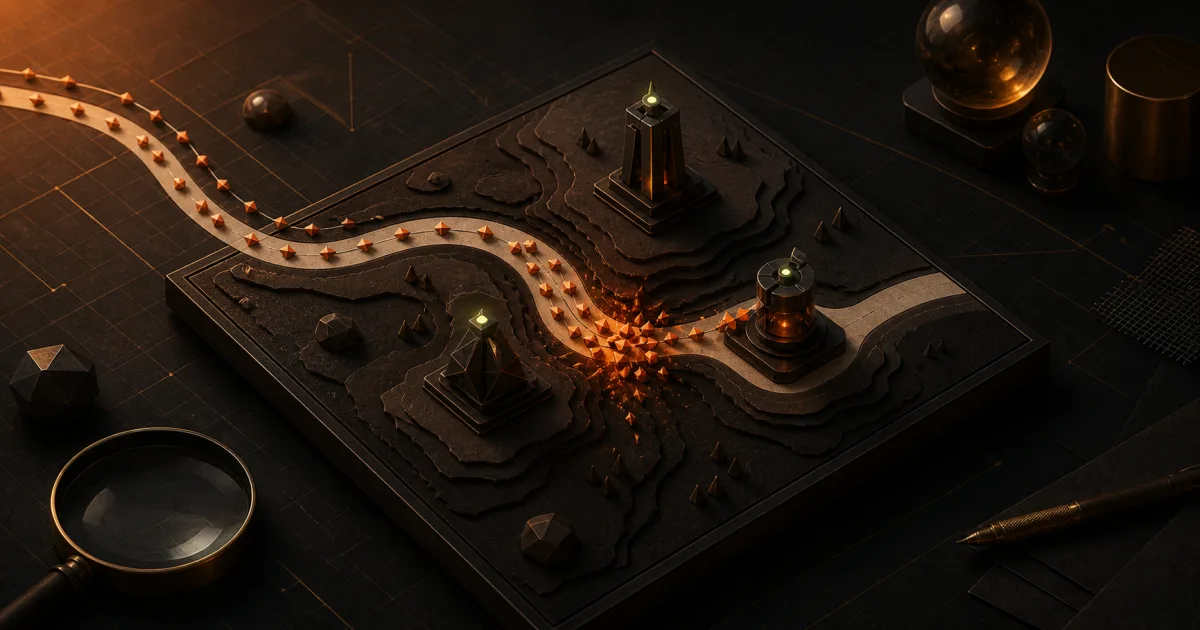
You set down a tower. You watch the wave hit. For a few seconds you know exactly how good your plan was. That feedback loop is short, honest, and a little addictive.
Tower defense has survived for years because the core craft holds up. Here’s what actually makes it fun, broken down piece by piece, so you can see the design choices behind the feeling.
You make real decisions, and they have weight
Every good tower defense run is a string of small bets.
Where do you place a tower? Which one do you build first? Do you save up for the expensive upgrade or spread thin and cover more ground? You don’t get to undo it. The wave is coming.
That matters because choices only feel good when they cost something. If every option were fine, nothing you did would matter. The fun comes from picking under pressure and then living with it.
- Limited money forces you to choose, not buy everything
- Fixed build spots make placement a puzzle, not a formality
- A wave that’s already moving means you can’t stall forever
The tension keeps climbing
A flat game gets boring fast. Tower defense fights that by ramping the pressure on a curve you can feel.
Early waves are gentle. You have room to breathe and set up. Then the enemies get tougher, faster, and weirder. Armor that shrugs off your main tower. Fliers that skip your maze. A boss that eats hits and keeps walking.
The trick is pacing. Each wave should feel a notch harder than the last, with the occasional spike that makes your heart jump. You’re never quite comfortable, but you’re never hopeless either. That edge is the whole point.
The “hold the line” payoff
Here’s the moment the genre is built around.
A wave breaks against your defenses. Enemies stack up at the chokepoint. One slips through, then another, and your health bar drops. You’re sure it’s over. Then your last tower lands the killing shots and the screen goes quiet.
You held. You earned it. Nothing handed it to you.
That relief-and-pride hit is hard to fake. It only lands because the danger was real a second ago. A game that’s too easy never gives you this. A game that’s unfair just feels cheap. Good tower defense lives in the narrow band where you barely make it, again and again.
Build, watch, tweak, repeat
The loop underneath all of this is simple: build something, watch it work or fail, then change it.
You learn the enemy. You spot the gap in your layout. You move a tower, swap an upgrade, reroute the path. Next attempt, you get a little further. This is the same itch behind optimizing anything. You’re tuning a machine and watching the numbers get better.
- Build your layout with what you have
- Watch the wave test it for you, instantly
- Tweak the weak spot you just found
- Repeat, a bit smarter each time
Mobile fits this loop perfectly. A wave is short. A run is a few minutes. You can think between attempts and feel yourself improving without burning an evening.
Variety keeps the loop from going stale
The base loop is strong, but it needs fresh problems to stay interesting.
That’s where towers with distinct jobs, enemies that demand different answers, and maps that reshape your plan come in. When a new tower changes how you think, or a new enemy type breaks your go-to strategy, the puzzle resets. You’re solving again instead of running on autopilot. Long-term progression, where your choices carry forward and unlock new options, gives all those small runs a bigger arc to climb.
Bottom line
Tower defense is fun because it stacks four durable things: real decisions with weight, tension that climbs, a hard-won payoff, and a tight build-and-improve loop. Get those right and the genre sells itself. Get them wrong and no amount of polish saves it.
Next time a tower defense game pulls you in for “one more wave,” now you know which gears are turning.
We’re building one ourselves. Tinyfort TD is an isometric tower defense game with six factions, ninety missions, twelve towers, and RPG-style progression, in development for iOS and Android. We’re chasing exactly the feeling above: hold the line, tweak, hold it again.
Want to see what we’re making? Follow along at Tinyfort TD.