
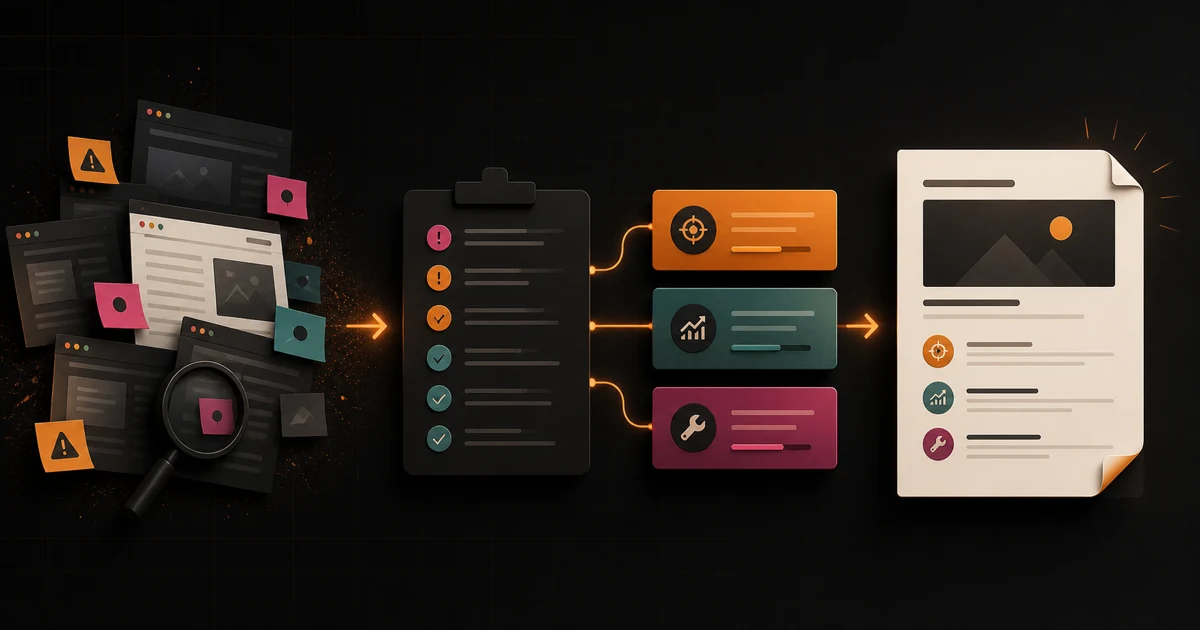
A website audit becomes valuable when a client can understand what you found, decide what matters, and approve what happens next.
That sounds obvious. Many audits still arrive as exported tool scores, long checklists, or screenshots with no decision attached. The findings may be technically correct, but the client is left to translate them into priorities, costs, and a plan.
For a freelancer or small agency, the better product is not “more warnings.” It is a defensible path from observation to action.
Start with the decision the audit should support
Define the audit around a client decision before opening a testing tool. Common decisions include:
- whether to repair or replace an existing site;
- which conversion problems to address first;
- what belongs in the next implementation phase;
- whether a proposed redesign preserves important content and functionality;
- which risks must be fixed before a campaign or launch.
This keeps the work bounded. A small-business marketing audit is not automatically a penetration test, legal opinion, accessibility conformance audit, or search-ranking guarantee. State the boundary in the intake and repeat it in the report.
Record evidence before writing recommendations
Every finding should preserve enough context for another person to reproduce it. At minimum, capture:
- the exact page or flow;
- the device, viewport, or test condition;
- what was observed;
- who is affected;
- the evidence source;
- what remains unknown.
“The mobile site is slow” is a weak finding. “On the tested mobile profile, the service page’s main image delayed the largest visible content; verify against production field data before changing delivery” is useful because it distinguishes observation, interpretation, and uncertainty.
Automated tools can identify candidates. They do not replace verification. A score may change between runs, an accessibility scanner cannot evaluate every success criterion, and a search tool cannot promise a ranking outcome. Keep the raw output as supporting evidence, then write the finding in plain language.
Connect each finding to a visitor and a business hypothesis
Clients approve work when they can see the connection between a site behavior and a real customer task.
For each verified issue, name the affected visitor and the interrupted action. A buried phone number affects someone trying to call. An ambiguous service page affects a buyer comparing providers. Missing keyboard focus affects visitors who navigate without a mouse.
Then state the business impact as a hypothesis, not a guarantee. Use language such as “may increase abandonment,” “creates uncertainty before the inquiry,” or “makes this control difficult to operate.” Avoid claims that a fix will increase revenue or rankings unless you have measurement that supports that conclusion.
Prioritize with impact, confidence, and effort
A client cannot act on 60 simultaneous priorities. Group findings into a small number of decision bands:
- fix now: verified issue, meaningful impact, and reasonable effort;
- schedule next: valuable but dependent on other work or more evidence;
- monitor: plausible concern that needs measurement;
- do not pursue: low-value, unsupported, or out of scope.
Use a scoring model to make the reasoning visible, but do not let the score pretend to be precise. A simple model that records impact, confidence, and effort is more honest than a complex formula built on guesses.
The executive summary should explain the top three to five priorities. The detailed appendix can preserve every tested item, including passes and items that could not be verified.
Write recommendations as acceptance checks
“Improve the call to action” is not a deliverable. A useful recommendation names the change and how the client will know it is complete.
For example:
Put one primary inquiry action in the mobile header and keep it keyboard reachable. Confirm it remains visible at the agreed breakpoints, has a descriptive accessible name, and opens the approved contact path.
That recommendation is easier to estimate, implement, and test. It also reduces disagreements later because the expected behavior is recorded before work begins.
Separate the audit from the implementation proposal
The audit explains the evidence and priorities. The proposal converts approved priorities into a commercial scope.
For each proposed work package, record:
- included deliverables;
- client dependencies;
- acceptance checks;
- exclusions;
- price and payment terms;
- change-control rules;
- the point at which new findings require a new estimate.
Do not quietly turn every audit finding into mandatory implementation work. Let the client choose a phase based on the evidence, constraints, and expected value.
Use a repeatable delivery system
A reusable system protects quality when deadlines get tight. It should cover intake, testing, evidence capture, prioritization, report writing, scoping, and final QA. It should also preserve uncertainty instead of encouraging confident filler.
Fireproof Studio’s Website Audit Revenue Kit packages that workflow into an editable 60-row audit workbook, client report, implementation proposal, evidence-safe AI prompts, a fictional completed example, and a single-business commercial license. It is a $149 one-time purchase for freelancers and small agencies.
Whether you build your own system or use ours, judge the final audit by one test: can the client trace every recommended project back to a verified observation and a clear acceptance check? If yes, the audit is doing more than reporting problems. It is helping the client make a decision.