
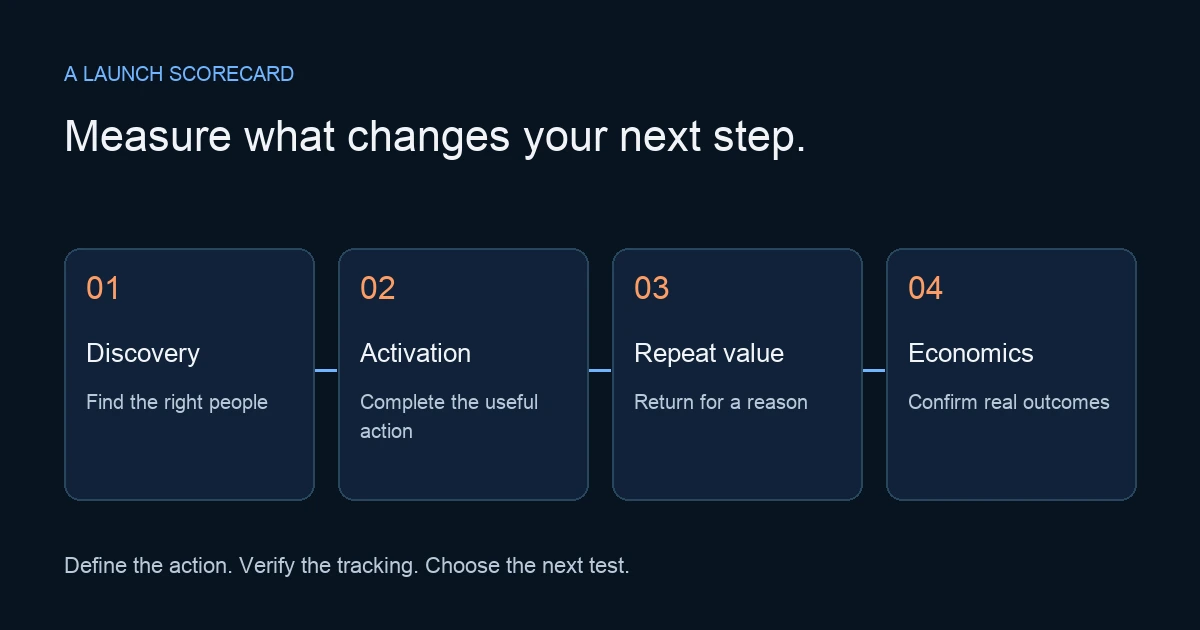
A launch scorecard should help you decide what to fix next. Start with the customer action the product exists to support, then work backward to the steps that make it possible.
For a service website, that might be a completed inquiry. For a game, it might be finishing the first level and choosing to return. For a paid tool, it might be receiving a successful purchase and using the download. These are examples, not reported Fireproof Studio results.
Define the action before counting it
Write down exactly what counts as success. A click on “Contact” is different from a submitted inquiry. Opening checkout is different from a settled payment. Downloading a game is different from playing it.
Google Analytics calls important collected actions key events. The label does not make an action valuable; your definition does. Choose the event that represents the outcome, rather than the easiest button to track.
Test one successful journey and one unsuccessful journey. Confirm that success records once, failure does not look like success, and the result reaches the report you plan to use. Label missing tracking as missing data, not zero demand.
Keep four questions separate
- Discovery: Are the right people finding the product? Search Console reports search impressions, clicks, and queries. These describe search visibility, not purchases.
- Activation: Can someone complete the first useful action? Record the completed action and where people stop before it.
- Repeat value: Do people return to do something useful again? Choose a return window that fits the product; a monthly planning tool needs a different window from a daily game.
- Economics: What revenue actually settled, and what refunds or operating costs belong to it? Keep these records separate from analytics estimates.
A rise in visits with no completed actions suggests a different investigation from steady activation with poor repeat use. Combining everything into one “engagement” number hides that distinction.
Set a review window and a decision rule
Before changing the product, record the current version, date range, traffic source, and number of eligible users. Compare like with like. A handful of visitors can reveal a broken form, but it is a weak basis for declaring a conversion trend.
Use a concrete rule: “If new users stop at account setup, inspect that step and test the revised journey.” That produces an action. “Improve engagement” does not.
Ignore numbers without a next step
Total views, followers, and downloads can provide context. Treat them as supporting evidence until you can connect them to a customer action or an operational decision.
Keep the scorecard small enough to review regularly. Include failures, missing data, and the next test alongside successes. The useful report is the one that changes what you do next.
If you need help connecting a website or application to a measurable customer journey, talk to Fireproof Studio about your project.