
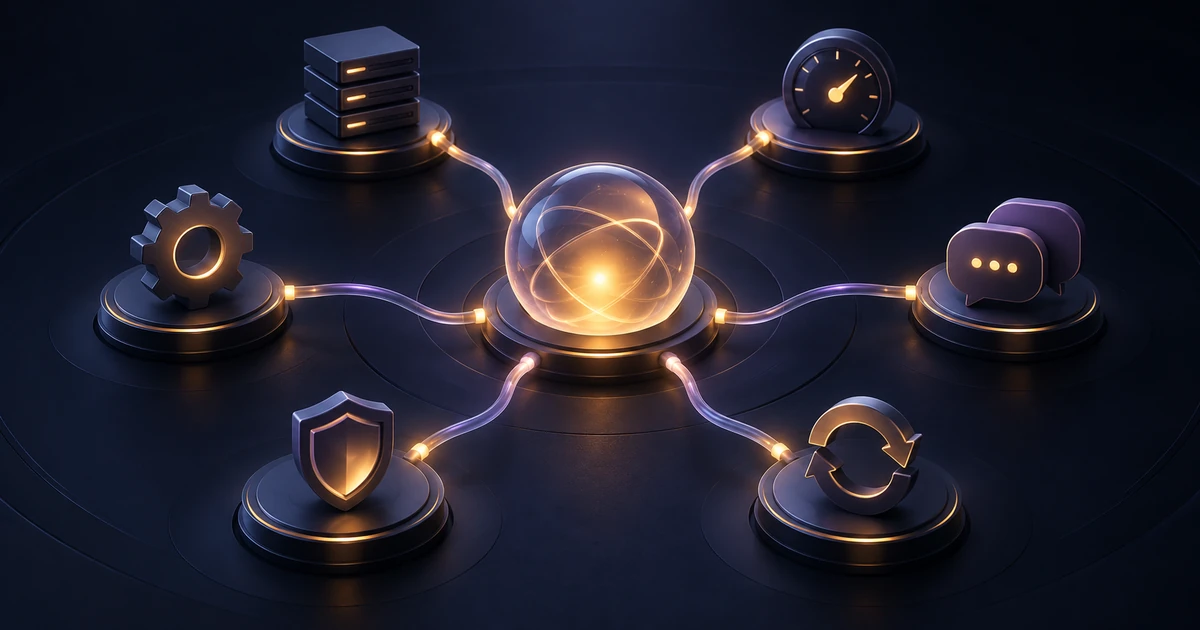
Affordable software is not only a small build or a low service bill. It is a promise that someone must keep after launch.
If the promise is “your team can share a checklist and recover it later,” the operating work includes more than the screen where the checklist is written. The application needs a place to run, a place to store data, a way to observe failures, a recovery path, maintenance, support, security work, and a controlled way to deliver changes.
Those responsibilities do not all change for the same reason. Some continue while the software is quiet. Some respond to usage. Some appear when a vendor changes a service or when a dependency needs attention. Others consume human time only when something goes wrong.
A useful review of software operating costs therefore starts with responsibilities and evidence, not a guessed total. The goal is to show what must remain true, what changes the work, who owns the response, and which question still needs an answer.
Start with one customer promise
Write one sentence that describes the result the software is expected to support. Keep it narrower than the product vision.
For example:
An event team can create a shared checklist, assign each item, and retrieve the completed record after the event.
That sentence does not specify a server, database, email provider, or monitoring platform. It gives those choices something to serve. It also exposes the responsibilities that a feature list can hide:
- the checklist must be saved somewhere;
- assignments must reach the intended people;
- an operator needs evidence when delivery or storage fails;
- the record needs an appropriate recovery path;
- changes must not silently break the completed-record workflow;
- someone must answer a support request and decide what happens next.
AWS’s Cost Optimization Pillar covers design, delivery, maintenance, service selection, configuration, and operation as parts of cost-aware cloud work. That is AWS guidance for AWS environments, not a universal operating model. The useful principle here is narrower: include the work of keeping the outcome available, not only the resources used to build the first version.
Copy this software operating cost worksheet
The completed example below is fictional. Lantern List is an imaginary browser-based checklist used by a small event team. It is not a Fireproof Studio product, a customer result, or a cost forecast. The rows identify responsibilities and evidence without assigning amounts.
On a phone or other narrow screen, swipe the table horizontally to read every column.
| Customer promise | Operating responsibility or cost driver | What makes the work or usage change | Cost shape: recurring, usage-sensitive, event-driven, or human time | Accountable owner | Evidence source | Review cadence or trigger | Failure or exception response | Next decision or open question |
|---|---|---|---|---|---|---|---|---|
| The team can open, update, and save a shared checklist | Infrastructure: application runtime, database, file storage, and delivery traffic | More workspaces, saved items, attachments, requests, or retained history | Recurring and usage-sensitive | Application owner | Resource inventory, provider usage reports, configuration record, and service bill | After a material feature change and on the team’s scheduled operating review | Identify the affected component, preserve evidence, limit further change, and follow the documented recovery or service-adjustment path | Which usage signal should cause a capacity or architecture review? |
| Assigned people receive the notification path the product promises | Vendor services: transactional email and account-sign-in provider | More invitations, assignment changes, sign-ins, provider limits, or vendor policy changes | Usage-sensitive and event-driven | Integration owner | Vendor delivery records, current plan documentation, configuration inventory, and test receipt | When the notification workflow changes, a vendor announces a change, or delivery evidence is incomplete | Keep the checklist usable, record the missing notification, use the approved fallback, and investigate without sending duplicates | Which vendor dependency needs a tested fallback, and what does that fallback actually preserve? |
| An operator can tell whether the main checklist path is working | Monitoring: service signals, logs, dashboards, and alert routing | More components, new failure modes, changed traffic patterns, or an alert that reaches the wrong owner | Recurring, usage-sensitive, and human time | Operations owner | Monitoring configuration, alert test record, service signals, incident notes, and routing roster | After each material workflow change and whenever an alert is missed or unactionable | Confirm customer impact before acting, route the issue to the named owner, and preserve enough evidence to reproduce the condition | Which signal leads to a specific action instead of merely adding dashboard noise? |
| A user with a problem can reach someone who owns the next step | Support: request intake, triage, explanation, correction, and escalation | More requests, repeated confusion, new features, or an issue that crosses ownership boundaries | Human time and event-driven | Support owner | Support queue, issue categories, response record, and product decision log | When a pattern repeats, ownership is unclear, or a release changes the user path | Acknowledge the observed issue, separate facts from assumptions, assign one owner, and communicate the next verified state | Which repeated request should change documentation, interface copy, or the product itself? |
| The checklist continues to work as its software environment changes | Maintenance: dependencies, supported runtimes, data migrations, and release verification | Dependency advisories, platform changes, deprecated interfaces, or a product change | Event-driven and human time | Engineering owner | Dependency inventory, vendor release notes, change record, test evidence, and deployed version | On the maintenance calendar and when a relevant upstream change is announced | Assess affected behavior, prepare a bounded change, verify the original path, and retain a documented rollback route | Which component has an unknown owner or unsupported update path? |
| Security work is part of development and operation rather than a launch-only task | Security work: access review, secure-development practices, vulnerability response, and change review | New data flows, dependencies, roles, reports, or identified weaknesses | Recurring, event-driven, and human time | Security owner with engineering support | Access inventory, dependency and change records, review findings, and closure evidence | At defined review points and when the software, threat evidence, or access model changes | Limit exposure, preserve evidence, route the finding to the authorized owner, verify the correction, and keep unresolved risk visible | Which security responsibility exists in practice but is missing from the operating plan? |
| A saved checklist has a defined recovery path | Recovery: backup verification, restore rehearsal, incident coordination, and return-to-service evidence | More stored data, data-model changes, failed jobs, operator error, or an outage | Recurring, event-driven, and human time | Recovery owner | Backup status, restore instructions, rehearsal record, incident timeline, and post-recovery verification | After a material data change, on the recovery-review schedule, and after an actual failure | Protect source evidence, identify the last verified state, use the approved recovery path, and verify the customer workflow after restoration | What has been restored successfully, and what is only assumed recoverable? |
| Users receive the intended version through the intended channel | Distribution: release packaging, hosting publication, version records, and user-facing change notes | A new release, a supported-platform change, a corrected defect, or a distribution-channel requirement | Event-driven and human time | Release owner | Source revision, artifact identity, deployment record, release notes, and post-release checks | Before and after each release and whenever the delivery channel changes | Stop the release when identity or evidence is unclear; otherwise use the approved rollback or correction path and recheck the original scenario | Which release fact must be visible to users, support, or the next operator? |
The worksheet is not an accounting statement. It is a responsibility map. Replace the fictional rows with the actual promise, systems, evidence, owners, and decision triggers for the software being reviewed.
Separate the shapes of operating work
A single total hides the reason work changes. Classify each row before trying to compare it with anything else.
Recurring responsibilities continue on a schedule or while the service exists. A base hosting resource, a domain, a review cadence, or a maintained support channel may belong here. Verify the exact terms rather than assuming that every recurring item is fixed.
Usage-sensitive responsibilities change with a measurable activity such as requests, storage, transfers, messages, builds, or retained records. The useful question is not simply “How many users?” One user uploading large files may create a different operating pattern from many users reading short records.
Event-driven work appears because something changed: a vendor notice, dependency advisory, incident, release, migration, or product decision. It may be rare without being optional.
Human time includes triage, support, investigation, maintenance, review, recovery, and coordination. It is easy to omit because it may not appear in a provider dashboard.
AWS’s expenditure and usage awareness guidance says understanding costs and their drivers requires gathering, analyzing, and reporting usage data, and it notes that changes in usage drive changes in cost. Keep that statement in its AWS context. For another provider or a self-hosted system, use the current billing unit and operational evidence for that exact system.
Count repeated manual work without pretending it is free
Some operating work is visible only in a person’s calendar or support queue. A repeated manual step may begin as a reasonable response and later become a substantial part of operating the product.
Google’s SRE chapter on eliminating toil describes toil as service-related work with characteristics such as being manual, repetitive, automatable, and prone to growing with the service. That large-scale SRE framing is not a staffing formula for a small product. It is a prompt to record repetitive work instead of leaving it outside the worksheet.
For each repeated task, capture:
- what starts it;
- what the operator actually does;
- what evidence shows completion;
- what happens when the operator is unavailable;
- whether the task should be simplified, batched, documented, partially automated, or left manual for a reason.
Automation can create its own maintenance and failure paths. Do not replace a visible manual responsibility with an invisible automated one. If a workflow is automated, connect it to an automation failure plan that names run evidence, alert ownership, safe retry boundaries, and recovery verification.
Give monitoring a decision, not just a dashboard
Monitoring is operating work because someone must choose signals, maintain collection, route alerts, investigate exceptions, and update the system when the evidence stops being useful.
Google’s SRE chapter on monitoring distributed systems distinguishes purposes such as trend analysis, alerting, dashboards, and retrospective debugging. It also presents latency, traffic, errors, and saturation as a set of signals for user-facing systems. Those examples come from Google’s SRE context. A small product still needs to select signals for its own architecture and customer promise.
For every signal, write the decision it supports:
- investigate a failed customer action;
- review a capacity assumption;
- contact a vendor;
- start the recovery procedure;
- correct alert routing;
- or record that no action is warranted.
If a graph never changes a decision, question why the team is collecting, storing, and reviewing it. If an important decision has no evidence, record that gap rather than inventing a healthy status.
Keep security and recovery inside the operating model
Security work is not represented by one tool or one launch review. NIST’s Secure Software Development Framework is a set of high-level practices intended to be integrated into a software development lifecycle. The publication offers common practices and vocabulary; citing it does not certify a product, prove that a control is complete, or determine the exact work required for a particular system.
In the worksheet, name the actual recurring and event-driven responsibilities. These may include reviewing access, tracking dependencies, responding to identified weaknesses, checking changes that affect data flows, and retaining evidence that a correction was verified. The exact plan depends on the product, its data, its users, and its current technical design.
Recovery belongs in the same model. A backup indicator is evidence that a process reported something. It is not the same evidence as reading a restored record through the customer workflow. Record separately what is backed up, what has been restored in a controlled test, who can authorize recovery, and what still remains unverified.
Assign an owner and a response before the exception
An operating responsibility without an owner becomes a surprise shared by everyone and handled by no one.
“Engineering” or “the vendor” may be too broad. Name the role that checks the evidence and decides what happens next. The person doing every step does not need to be the same person, but the handoff must be visible.
Then write a response that is specific enough to use. “Investigate” is not a complete response. A stronger entry might say:
- preserve the failed request identifier and current configuration;
- stop repeated attempts that could duplicate work;
- route the case to the integration owner;
- keep the main workflow available through the documented fallback;
- verify the final customer-visible state before closing the issue.
AWS’s guidance to optimize over time recommends reviewing architectural decisions as services and requirements change, and it explicitly includes the effort involved in operations. Use that as a reminder to revisit the owner, evidence, and response—not as proof that a newer service or more automation is automatically the right decision.
Review the map when the product changes
Do not wait for an annual planning exercise if the operating model changed yesterday. Review the relevant rows when the team adds a dependency, changes a data flow, introduces a new release channel, expands stored history, changes a support promise, or discovers an exception the worksheet did not cover.
Use actual evidence:
- current resource and vendor inventories;
- the billing units documented for the selected services;
- provider usage records and service bills;
- support and incident records;
- maintenance and security findings;
- backup and restore evidence;
- release identities and post-release checks;
- recorded human work that does not appear in vendor reports.
Then compare the map with what the product actually accomplishes. Our post-launch measurement guide separates discovery, completed customer actions, repeat use, and real outcomes from numbers that merely look active. Keep that customer evidence separate from the operating-cost worksheet, then use both views to decide what needs attention.
This article does not tell a team what to charge or whether a particular product should continue. It provides a way to replace an incomplete guess with named responsibilities, current evidence, and explicit questions.
Affordable software needs visible ownership
The build creates the first version. Operation keeps the promise understandable and reviewable.
Start with one customer outcome. Map every responsibility that supports it. Classify what changes the work. Name the owner, evidence, review trigger, and exception response. Leave unknowns visible until evidence answers them.
That will not produce one universal cost. It will produce something more useful: a current operating model that shows where the software depends on resources, vendors, maintenance, recovery, support, security work, distribution, and people.
Need help planning or improving an application? Tell Fireproof Studio what the software needs to accomplish.